Material Science
Why WACKER Silicone LOCA Prevents Yellowing and Bubbles in Industrial Touch Displays
Two of the most common complaints from overseas buyers sourcing optically bonded displays are screen yellowing after outdoor deployment and bubble formation following thermal cycling. Both failures trace back to adhesive material selection. This article explains why KoreTouch uses genuine WACKER silicone LOCA and what the chemistry means for display longevity in demanding environments.
1. The Problem Buyers Encounter in the Field
Buyers who have sourced optically bonded industrial monitors or all-in-one PCs from lower-cost manufacturers tend to report the same two issues after six to eighteen months of deployment. The first is visible yellowing of the display. The screen ships with acceptable optical clarity, but within one to two seasons of outdoor or high-UV-exposure operation, a brown-yellow tint develops across the bonded area. It cannot be cleaned off because it is inside the laminated stack. The unit requires full rework or replacement.
The second issue is bubble formation. The screen ships clean, but after the equipment has gone through repeated temperature swings between operating and non-operating states, small bubbles appear inside the bonded layer and gradually grow. Again, the failure is internal and not field-repairable.
Both failure modes are well understood at the material level. They are not caused by poor workmanship in isolation. They result from using adhesive chemistry that is not suited to the operating environment. Understanding why requires a brief look at what LOCA actually is and how different formulations respond to UV radiation and thermal stress.
2. What LOCA Is and Where the Chemistry Diverges
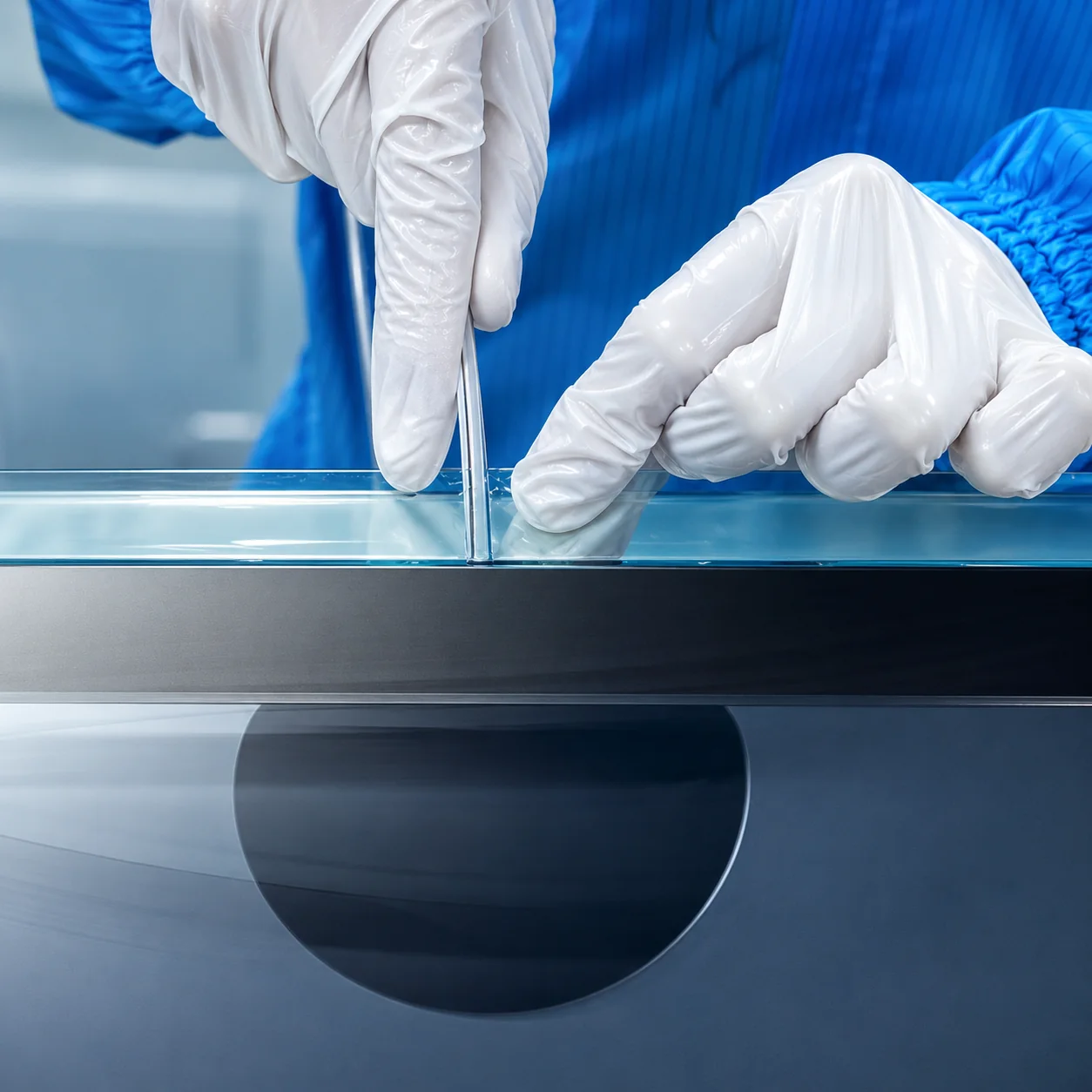
Liquid optical clear adhesive (LOCA) is the material injected between the LCD module and the cover glass during the optical bonding process. Once cured, it replaces the air gap with a solid, optically transparent medium. The primary optical function is refractive index matching: glass has a refractive index of approximately 1.5, and air has a refractive index of 1.0. This mismatch causes reflection at each interface. LOCA cured to a refractive index of approximately 1.49 eliminates that mismatch and reduces internal reflection to below 1%, which directly improves contrast under high ambient light.
The optical performance of different LOCA materials at the point of delivery is broadly similar. The divergence appears over time under UV exposure and thermal stress. This is where the molecular structure of the adhesive determines long-term field performance, and where the difference between acrylic-based and silicone-based LOCA becomes significant.
Acrylic LOCA uses a carbon-carbon molecular backbone. The bond dissociation energy of a carbon-carbon single bond is approximately 347 kJ/mol. UV-A radiation present in terrestrial sunlight carries photon energies in the range of 315 to 380 kJ/mol per Einstein, which is sufficient to initiate photodegradation in acrylic polymer chains over time. The adhesive undergoes oxidative crosslinking and chain scission. The optical outcome is the yellow-brown discoloration that field engineers observe on units that have been running outdoors or near UV-emitting light sources.
WACKER silicone LOCA uses a silicon-oxygen backbone. The Si-O bond dissociation energy is approximately 460 kJ/mol. Terrestrial UV radiation does not carry enough energy per photon to break this bond under normal operating conditions. The adhesive does not undergo the same photodegradation process. This is not a performance claim based on accelerated aging projections alone. KoreTouch conducts in-house UV aging tests on bonded assemblies. Units subjected to 500 hours of simulated high-UV exposure in our test chambers show no measurable change in transmittance or color coordinates. The chemistry is stable where acrylic alternatives are not.
3. Why Bubbles Form and How Silicone Handles Thermal Stress
Bubble formation in bonded displays is a thermal stress problem, not primarily a curing problem. The bonded stack consists of materials with different coefficients of thermal expansion: the metal housing, the cover glass, the LCD panel, and the adhesive layer all expand and contract at different rates as temperature changes. In a unit that cycles between sub-zero nights and hot daytime operating temperatures, this differential expansion generates shear stress at the adhesive interfaces repeatedly over the service life of the equipment.
Acrylic LOCA, once fully cured, behaves as a relatively rigid material. It has limited capacity to absorb shear strain elastically. Under sustained thermal cycling, the accumulated stress at the glass interface eventually exceeds the adhesive bond strength at localized points. The adhesive pulls away from the glass surface, and air is drawn into the gap. This is the bubble that appears in the display after field deployment. Once air has entered, the bubble grows with subsequent thermal cycles as the adhesive repeatedly pulls away from and partially reattaches to the glass.
WACKER silicone behaves differently after curing. It cures to a gel-like state with very low Shore A hardness. Rather than accumulating stress at the interface, it accommodates differential thermal expansion through elastic deformation of the adhesive layer itself. The interface bond is not put under the same cyclic loading that causes acrylic adhesives to delaminate. This property is why silicone LOCA is the standard choice for applications that involve significant temperature variation, including outdoor equipment, vehicle-mounted displays, and cold-storage environments.
There is a process variable that also contributes to bubble formation in delivered units: inadequate defoaming during production. Even with silicone LOCA, microscopic air inclusions can be trapped during the injection stage if process controls are insufficient. KoreTouch's bonding protocol includes an autoclave defoaming stage after the initial UV pre-cure. The assembly is placed under controlled pressure, which forces residual micro-bubbles to dissolve into the adhesive matrix before final thermal curing. Final optical QC then verifies cleanliness under varied color background illumination before any unit is released for shipment.
4. Why KoreTouch Specifies WACKER and Not a Generic Silicone Alternative
Silicone LOCA is available from multiple suppliers at a range of price points. The decision to specify WACKER Chemie AG material rather than a lower-cost alternative is based on consistency of supply specifications and validated performance data.
The optical and mechanical properties of LOCA materials vary between batches from different suppliers, and between suppliers whose quality control systems are less rigorous. Refractive index tolerance, viscosity for injection, and post-cure Shore hardness all affect the finished display performance. For a production operation running bonded assemblies through a Class 1,000 cleanroom with defined process parameters, the adhesive needs to behave predictably across every batch. WACKER's material specifications are consistent and well-documented, which is a practical requirement for process-controlled production rather than a branding consideration.
KoreTouch has been bonding displays using WACKER silicone LOCA since we established our optical bonding line. The material performance in our production environment is known from direct experience across multiple product generations and deployment environments, including outdoor kiosks, factory automation HMIs, and vehicle-mounted displays. When buyers ask us why we use a German adhesive rather than a locally-sourced alternative, the answer is that the performance difference is observable in field return data, and the cost difference per unit is small relative to the cost of a warranty return or site service call.
5. What This Means for System Integrators Evaluating Bonding Suppliers
When evaluating optical bonding suppliers, the most important question to ask is not the headline bonding price. It is what adhesive material is being used and what documentation the supplier can provide for its optical and mechanical properties. A supplier using commodity acrylic LOCA at a lower unit cost will produce displays that pass incoming inspection. The failure appears in the field after UV exposure accumulates or after the first winter-summer thermal cycle.
For applications where the display will be deployed indoors under stable temperature and light conditions, the material choice is less critical. For any application involving outdoor installation, significant temperature variation, or UV-emitting light sources in close proximity, the adhesive chemistry matters and the cost of a field failure significantly exceeds the cost difference between adhesive grades.
KoreTouch provides material documentation for the WACKER LOCA used in our bonding process on request. Buyers who want to verify the adhesive specification before placing production orders can request this as part of the pre-production qualification process. Technical inquiries can be submitted through our contact page. Further detail on our overall bonding process, including the 8-step protocol and process validation stages, is available on the Optical Bonding page.
6. Conclusion
Yellowing and bubble formation in optically bonded industrial displays are material failures, not workmanship failures in isolation. Acrylic LOCA degrades under UV radiation because its carbon-carbon backbone cannot withstand the photon energy levels present in terrestrial sunlight over time. It delaminates under thermal cycling because its cured rigidity does not accommodate differential expansion elastically. WACKER silicone LOCA avoids both failure modes through its silicon-oxygen chemistry and gel-like post-cure behavior. Combined with process controls including autoclave defoaming and final optical QC, the material basis for long-term display reliability in harsh environments is established before a unit leaves our facility. System integrators sourcing bonded displays for demanding applications should treat adhesive material specification as a primary evaluation criterion, not a manufacturing detail to be assumed.