Technical Deep Dive
Cracking Touch Failures in Complex EMI Environments: Physical Boundaries and Algorithmic Breakthroughs in PCAP Signal Processing
In the evolution of industrial HMI, the adoption of Projective Capacitive (PCAP) technology has not been without its hurdles. For precision medical equipment, outdoor transit terminals, and highly automated factory floors, Electromagnetic Interference (EMI) is the “invisible killer” of system stability. At KoreTouch, we believe that PCAP tuning is essentially a signal game played in an environment with an extremely low Signal-to-Noise Ratio (SNR).
Part I: Physical Origins and Coupling Paths of Interference
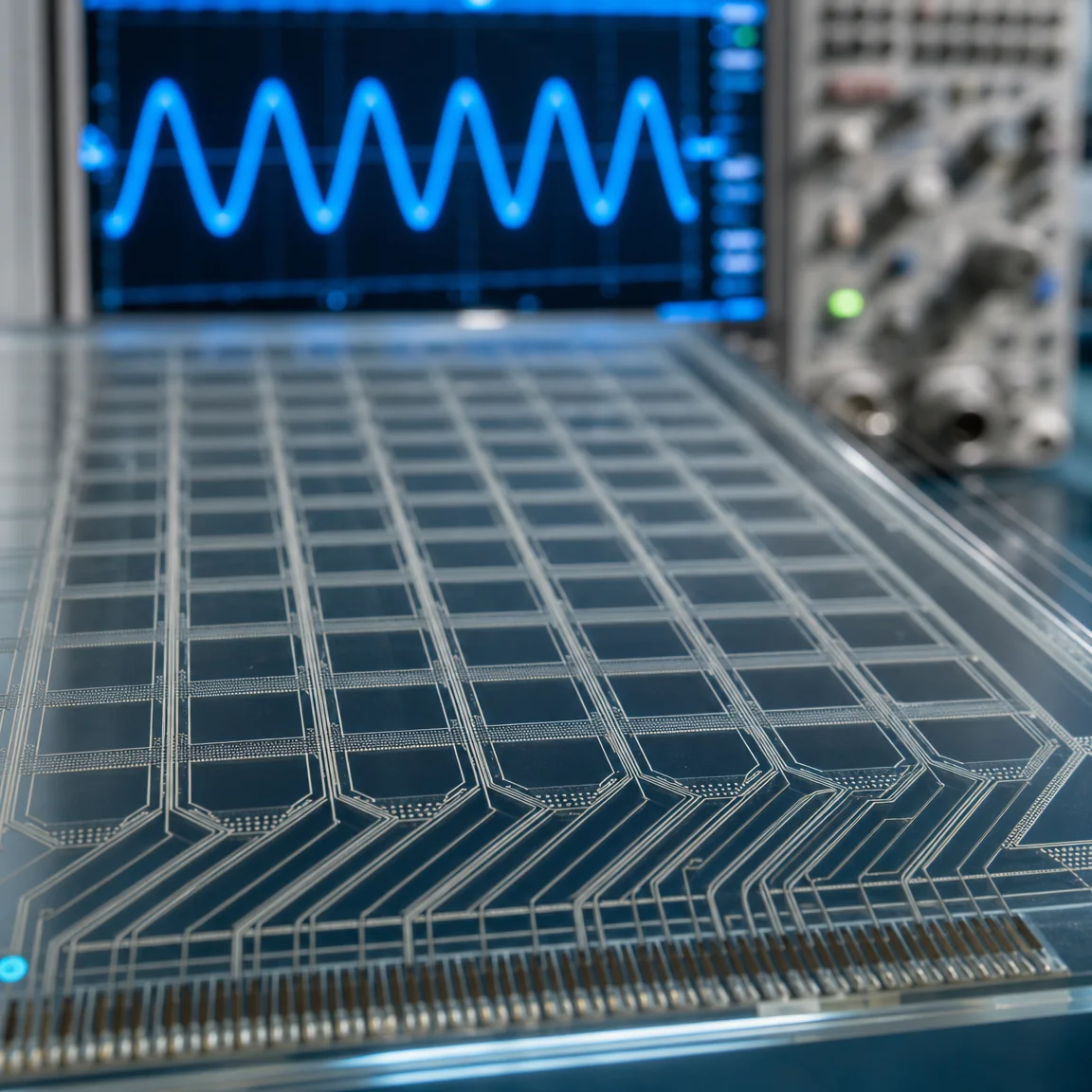
Industrial environments are saturated with a mix of high-frequency and low-frequency electromagnetic noise. Variable Frequency Drives (VFDs) generating power to large motors produce significant conducted interference, while radio communications or high-power switching power supplies couple through radiation into the sensor's ITO conductive layer. A PCAP sensor is essentially an ultra-sensitive charge collector; any fluctuation in the external electric field can be misinterpreted as a finger touch. In systems lacking deep optimization, this results in “ghost touches” or total response blockage, directly threatening operational safety.
Part II: Multi-frequency Collaborative Scanning and Adaptive Frequency Hopping (AFH)
To overcome this deadlock, KoreTouch developed Adaptive Frequency Hopping firmware logic. Traditional controllers operate at a single fixed frequency; once that band is occupied by noise, communication ceases. Our system performs a full-spectrum self-test upon startup, identifying the region with the lowest background noise as the primary frequency. During operation, the algorithm monitors the SNR in real-time. If an abnormal noise amplitude is detected, the system executes a smooth frequency hop within milliseconds. This dynamic avoidance capability ensures that devices maintain stable coordinate output even in power rooms with strong magnetic interference.
Part III: Differential Sensing Algorithms and Decoupling Complex Interactions
In practical applications, clients often require operation through reinforced glass over 10mm thick or while wearing heavy protective gloves. This further weakens the mutual capacitance between the finger and the sensor. Simply increasing gain amplifies noise. Our core breakthrough lies in Differential Sensing Algorithms. By measuring the difference in charge between adjacent sensing channels rather than absolute values, we effectively cancel common-mode noise. This means that even in the presence of water streaks, oil stains, or thick media, the system accurately strips away background noise to lock onto the true interactive intent.
Conclusion: PCAP Tuning—The Micro-Foundation of Industry 4.0
Within the underlying logic of PCAP technology, the struggle between signal and noise is eternal. However, for the expert team at KoreTouch, the significance of tuning extends far beyond mere parameter adjustment. We are not just solving for click accuracy under interference; we are mitigating the risk of “unplanned downtime” in industrial production. As global manufacturing pivots toward intelligence, the HMI has evolved from a simple switch replacement into a complex control hub. A screen that falters in the face of electromagnetic surges can cause a multi-million dollar production line to halt unexpectedly or trigger severe safety incidents. Therefore, we view PCAP tuning as “Engineering for Certainty.” KoreTouch remains at the forefront of charge sensing, ensuring that your every interaction is precise, secure, and reliable.