Technical Deep Dive
KoreTouch Advanced Display Technologies: Optical Bonding, Touch Integration, and Engineering for Harsh Environments
A structured review of the core technologies KoreTouch applies across its industrial touch monitor and all-in-one PC product range, covering WACKER silicone LOCA bonding, PCAP sensor and controller integration, and application-specific engineering for medical, industrial, outdoor, and transportation deployments.
1. Introduction
Buyers sourcing industrial touch monitors or all-in-one PCs for demanding deployment environments consistently encounter the same set of problems. Screens turn yellow after months of outdoor exposure. Internal fogging appears when equipment moves between temperature zones. Touch response becomes erratic near motor drives or frequency inverters. Displays delaminate after sustained vibration. These are not manufacturing defects in the conventional sense. They are the predictable result of using display hardware built to consumer tolerances in environments those tolerances were never designed to cover.
KoreTouch is an optical bonding factory and touch display manufacturer operating in China. Our product range covers bonded touch monitors and industrial all-in-one PCs from 5 to 86 inches, supplied to system integrators and OEM buyers across industrial automation, medical equipment, outdoor infrastructure, and transportation sectors. This article gives a technical account of the core technologies we apply: the material science behind our optical bonding process, the engineering decisions that govern PCAP touch performance in industrial environments, and the application-specific configurations we use across our primary vertical markets.
2. Optical Bonding: The Physics of the Air Gap and Why It Has to Go
The starting point for understanding optical bonding is the refractive index. Glass has a refractive index of approximately 1.5. Air has a refractive index of 1.0. When light crosses a boundary between two materials with different refractive indices, a portion of it reflects back rather than passing through. Fresnel's equations define this relationship precisely. At normal incidence, each glass-to-air interface in a standard air-bonded display reflects approximately 4% of incoming light. A conventional assembly has two such interfaces, producing a combined internal reflection of around 8%. In outdoor conditions or under bright industrial lighting, this reflected light competes directly with the image the display is trying to produce. The visible result is a washed-out screen that experienced engineers know well.
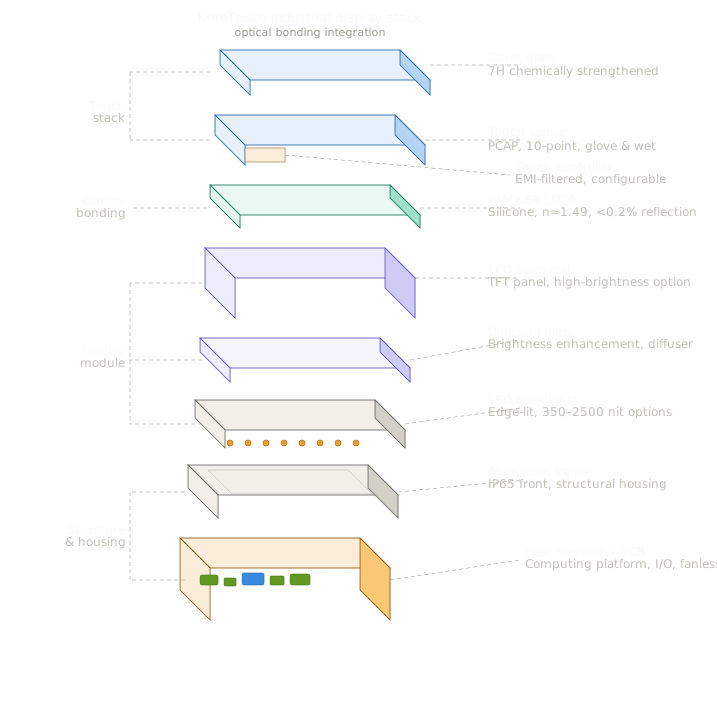
Optical bonding eliminates the air gap by injecting liquid optical clear adhesive between the LCD module and the cover glass and curing it into a solid, continuous optical medium. KoreTouch uses WACKER Chemie AG silicone LOCA, sourced from Germany. WACKER silicone cures to a refractive index of approximately 1.49, close enough to the surrounding glass that the index mismatch at the internal interfaces becomes negligible. Internal reflection in a bonded unit drops below 1%. The practical effect on a high-ambient-light installation is significant: contrast is preserved, the backlight operates more efficiently, and the display remains readable at luminance levels that would require a much higher-power panel in an air-bonded configuration.
Beyond the optical outcome, filling the gap eliminates the enclosed air cavity that causes internal fogging. In air-bonded monitors, water vapor inside that cavity condenses on the cooler glass surface when equipment moves from a warm environment to a cold one, or when ambient humidity rises rapidly. The condensation is trapped and produces permanent visual obstruction. With optical bonding, there is no cavity and no condensation pathway.
3. Why WACKER Silicone and Not an Acrylic Alternative
Acrylic-based LOCA materials are widely available and less expensive than silicone alternatives. Most low-cost optical bonding operations use them. The performance gap becomes visible over time rather than immediately, which is one reason buyers do not always connect field failures to the bonding material choice.
Acrylic adhesives rely on a carbon-carbon molecular backbone. The bond energy of this structure is approximately 347 kJ/mol. High-energy UV photons in terrestrial sunlight carry enough energy to break this bond progressively. After sustained outdoor exposure, the adhesive undergoes photodegradation. The visual outcome is yellowing and a reduction in optical transmittance that cannot be reversed without removing and rebonding the display assembly.
WACKER silicone uses a silicon-oxygen backbone. The bond energy is approximately 460 kJ/mol, above the photon energy range present in ground-level UV radiation. The silicone does not undergo the same photodegradation process. In accelerated aging tests conducted in our workshop, bonded units subjected to 500 hours of simulated high-UV exposure show no measurable discoloration. This is not a theoretical claim about the chemistry. It is a result we verify on actual bonded assemblies before signing off on material qualification.
The second performance difference concerns thermal cycling. Equipment installed in outdoor enclosures or vehicle cabins experiences significant temperature swings between day and night, or between operating and non-operating states. Metal housings, glass layers, and adhesive materials all expand and contract at different rates. This differential expansion generates shear stress at the adhesive interfaces. Hard acrylic adhesives cannot accommodate this stress elastically. Over repeated thermal cycles, the adhesive layer progressively shears away from the glass surface and draws in air, forming vacuum bubbles that are trapped inside the bonded assembly.
Cured WACKER silicone behaves as a high-elasticity gel with very low Shore hardness. It accommodates differential thermal expansion through elastic deformation rather than accumulating stress at the interface. The bonded stack maintains integrity across the operating temperature range without developing bubbles or delamination. Our standard bonding protocol also includes an autoclave defoaming stage after the initial UV pre-cure, which drives any residual microscopic bubbles into solution before final thermal curing. Every unit we ship passes final optical QC under varied color backgrounds specifically to verify that no bubbles or dark spots are present.
The upfront cost of WACKER silicone relative to acrylic alternatives is higher. That cost is recovered over the service life of the equipment through lower field failure rates and reduced warranty returns. For system integrators managing installations with multi-year service commitments, this trade-off is straightforward. Our full bonding process documentation is available on the Optical Bonding page. For a dedicated material-science treatment, see our article on WACKER silicone LOCA anti-yellowing performance.
4. PCAP Touch Integration: Sensors, Controllers, and Industrial Environment Variables
Projected capacitive touch technology is the standard for industrial human-machine interface applications. PCAP touch panels operate by detecting the change in capacitance at the intersection of a sensor electrode grid when a conductive object, typically a finger, contacts or approaches the cover glass surface. The controller samples this capacitance map continuously and reports touch coordinates to the host system. This basic mechanism is well understood, but its performance in industrial environments depends on engineering decisions that go beyond the sensor pattern itself.
Electromagnetic interference is the most common source of PCAP instability in factory deployments. Frequency inverters, servo drives, and switchgear generate conducted and radiated noise across frequency ranges that overlap with the excitation frequencies used by PCAP controllers. When this noise couples into the sensor electrode grid, it appears as false capacitance changes that the controller misinterprets as touch events. The result is phantom touches, tracking errors, or complete loss of response. Addressing this requires EMI filtering at the controller level and, in some cases, sensor shielding layer configuration. KoreTouch selects and validates touch controllers for compatibility with the EMI environment of the target application. Our article on PCAP performance in complex EMI environments covers the signal processing approaches involved in more detail.
Glove and wet-hand operation are additional requirements in several of the industries we serve. Standard PCAP sensors are optimized for bare skin contact, which provides a predictable capacitance coupling level. Industrial gloves, particularly thick rubber or insulating gloves, attenuate this coupling significantly. Water on the screen surface creates a different problem: it distributes capacitance changes across a broader area than a finger contact, which some controllers misinterpret as a large-area touch rather than a point contact. Both of these operating conditions require specific sensor sensitivity and controller algorithm configuration. Our bonded touch panels support 10-point touch tracking and are configured for glove and wet-hand operation as part of the standard product release process.
Cover glass specification is also part of the touch integration design. Standard cover glass on KoreTouch bonded displays is chemically strengthened to 7H pencil hardness. This level of surface hardness resists scratching from metal tool contact and repeated cleaning with industrial solvents. Anti-glare etching is available for installations where specular reflection from overhead lighting reduces screen readability. Anti-fingerprint surface treatment is available for high-traffic screens where contact mark accumulation is a hygiene or maintenance concern.
5. Medical and Healthcare Applications
Clinical environments place specific requirements on display hardware that go beyond standard industrial specifications. The most significant is chemical compatibility. Hospitals and healthcare facilities clean patient-adjacent equipment with disinfectants that include high-concentration isopropyl alcohol, quaternary ammonium compounds, and in some settings stronger oxidizing agents. Standard plastic bezels and rubber gaskets degrade under repeated exposure to these chemicals. The sealed front surface produced by optical bonding, combined with an appropriate front bezel material specification, provides a surface that tolerates hospital-grade cleaning protocols without degradation over the equipment service life.
The geometry of a bonded display front surface also matters in clinical settings. Air-bonded monitors with recessed bezel channels around the screen perimeter are difficult to clean thoroughly because fluids and particulates accumulate in those recesses. A fully bonded unit with a flat or near-flat front surface has no such accumulation points. Combined with an IP65-rated front panel, this configuration meets the cleaning and contamination control requirements of patient-adjacent and surgical-adjacent deployments. PCAP touch through sealed glass eliminates any mechanical openings around the touch-sensitive area that would otherwise require individual sealing.
6. Industrial Automation and HMI Applications
Factory automation environments combine mechanical, electrical, and contamination challenges that require coordinated engineering responses across the display enclosure, computing platform, and touch interface. High-frequency vibration from machinery is transmitted through mounting structures to the display enclosure and from there into the display assembly. In a standard air-bonded monitor, impact or sustained vibration transfers concentrated stress to the LCD panel through the cover glass. The bonded stack in a LOCA-bonded unit distributes this mechanical load across the entire adhesive layer, reducing peak stress at the LCD panel surface and improving resistance to both impact damage and vibration-induced fatigue.
Fanless chassis design addresses two factory environment problems simultaneously. Cooling fans draw air through the enclosure, and factory air contains conductive metallic particulates, fibres, and process chemicals that accumulate on internal circuit boards and eventually cause electrical failures. Fans are also the highest-wear mechanical component in computing hardware and the most common source of field maintenance calls. Eliminating the fan by using the metal chassis as a passive heat sink removes both failure modes. This requires that the chassis and internal layout be designed to conduct heat from the computing platform to the external enclosure surface efficiently, which is an engineering task we carry out in-house rather than relying on generic chassis designs.
Our technical analysis of the 23.8-inch industrial panel PC covers chassis thermal design, IP65 front panel sealing, and PCAP touch configuration for a specific factory automation product in more detail.
7. Outdoor Infrastructure Applications
Outdoor deployments concentrate the most demanding conditions into a single installation: direct solar radiation, temperature cycling between ambient extremes, precipitation, and in public-access locations, the risk of physical impact or vandalism. Optical bonding addresses the internal reflection problem and provides structural reinforcement, but outdoor readability also depends on backlight luminance matched to the ambient light level in the installation environment. Direct sunlight in equatorial or high-latitude summer conditions can exceed 100,000 lux. A display running a standard 350-nit panel with 8% internal reflection will not produce a readable image under these conditions. Outdoor-rated configurations at KoreTouch use high-brightness panels in the range of 1,000 to 2,500 nits depending on the installation latitude and enclosure design.
Higher backlight power generates more heat inside the display assembly, and solar loading adds further thermal input through the front glass. Enclosure thermal design for outdoor units accounts for both sources of heat. The WACKER silicone bonding layer contributes to thermal management by conducting heat from the LCD panel toward the front glass more efficiently than an air gap would, which assists in distributing the thermal load across the front surface area rather than concentrating it at the panel edges.
UV resistance of the bonding material is not optional for outdoor installations. As covered in the material science section above, acrylic-based adhesives degrade under sustained UV exposure. An outdoor kiosk running on an acrylic-bonded display in a high-UV environment will develop visible yellowing within months. The silicon-oxygen backbone of WACKER silicone is stable under these conditions. This is one of the reasons our material qualification process specifically includes UV aging testing rather than relying on the adhesive manufacturer's datasheet alone.
8. Aviation, Marine, and Transportation Applications
Mobile and vehicle-mounted displays extend the environmental requirements of fixed industrial installations into additional domains. Mechanical shock and vibration specifications for rail vehicles are defined in EN 50155. Marine electronics face salt mist exposure and humidity levels that exceed most terrestrial industrial environments. Aviation applications impose pressure variation requirements in addition to vibration and temperature range. Across all of these environments, the structural properties of the bonded display stack provide a starting point: the cured silicone layer absorbs shock and distributes vibration-induced stress in the same way it does in factory installations, and the sealed front assembly eliminates ingress pathways for moisture and salt-laden air.
Enclosure and mounting design for transportation applications must also address the specific vibration frequency profiles of the vehicle type. The resonance behavior of a display assembly mounted to a rail vehicle floor is different from one mounted to a ship bridge console, and the mechanical design should account for this. KoreTouch works with transportation system integrators during the specification phase to match chassis design, mounting interface, and display stack configuration to the vibration and shock requirements of the specific application.
9. Engineering Support for Custom Configurations
Standard product configurations cover the majority of industrial and commercial display requirements. For projects with non-standard operating temperature ranges, unusual interface requirements, custom form factors, or regulatory certification requirements for specific markets, our engineering team engages at the specification stage to define the required configuration and validate it before production release. The 5 to 86-inch bonding capability covers most display formats encountered in industrial and commercial projects, and our bonding process has been validated with WACKER silicone LOCA across that full range.
For OEM buyers managing their own product platforms, KoreTouch can supply bonded display assemblies as components for integration into customer-designed enclosures and computing systems. Technical datasheets and process documentation are available on request. Project inquiries can be submitted through our contact page.
10. Conclusion
Industrial display performance is built at the material and process level, not at the marketing specification level. The choice of bonding adhesive determines whether a display retains optical clarity after years of UV exposure or develops yellowing that cannot be corrected without rebonding. The bonding protocol determines whether a unit ships bubble-free or carries latent defects that appear in the field after thermal cycling. The touch controller configuration determines whether a PCAP panel operates reliably in the EMI environment of the installation or generates false inputs that require operator workarounds. These decisions are made before a product ships, and their consequences play out over the service life of the equipment.
KoreTouch applies WACKER silicone LOCA, validated bonding processes, and application-specific touch integration across our product range because these are the engineering foundations that produce field-reliable hardware. Buyers evaluating industrial display suppliers should ask for specific process documentation and material certifications rather than accepting general performance claims. We make that documentation available because it reflects what we actually build.