Engineering Excellence
Deep Dive into Optical Bonding: How Material Science Dictates Visual Longevity and Structural Resilience in Industrial Displays
The excellence of an industrial display is dictated not just by pixels, but by the rigor of its physical integration. While many manufacturers still rely on low-cost “perimeter bonding,” KoreTouch's engineering standard dictates that Optical Bonding is the ultimate solution for reliability in extreme environments.
Part I: The Physical Cost of Air Gaps
Traditional perimeter bonding retains an air gap between the LCD module and the cover glass. Optically, as light passes through glass, air, and the display, the drastic sudden change in the Refractive Index creates severe interfacial reflections. Total reflectivity often exceeds 13.5%, making the screen completely unreadable under direct sunlight. More dangerously, in outdoor environments or cold storage applications with sharp temperature fluctuations, moisture within the air gap condenses into fog (Internal Fogging), creating irreversible visual obstruction.
Part II: Molecular Evolution of Optical Clear Resin (OCR)
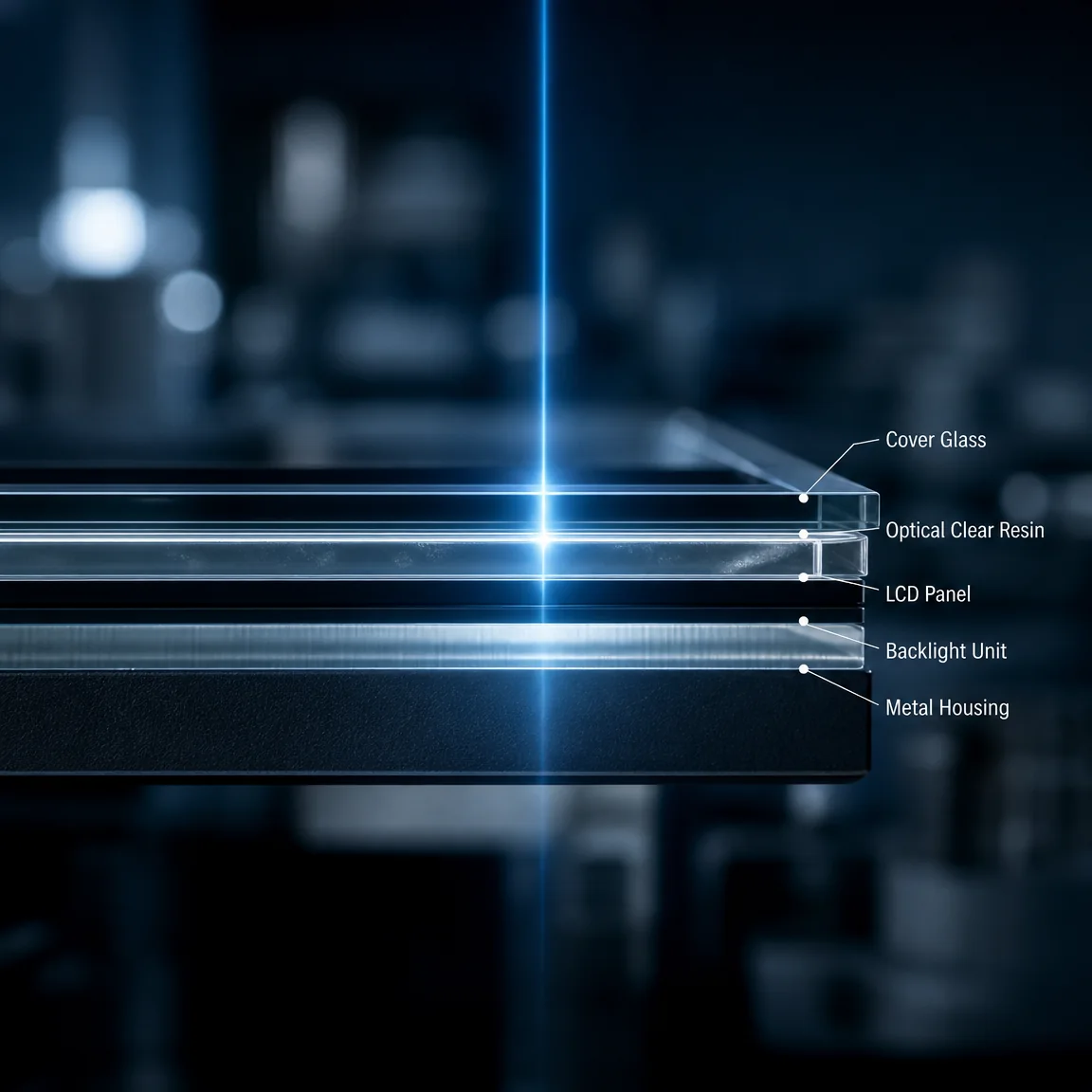
KoreTouch utilizes optical bonding to completely fill this void with liquid Optical Clear Resin (OCR). This is not a simple potting process; it is a precise exercise in chemistry and optical matching. We adjust the refractive index of the adhesive to closely match that of the glass (approximately 1.49), thereby eliminating the light refraction interface. Reflectivity is reduced to below 0.2%, allowing the screen to maintain cinematic black levels and color saturation even under intense glare.
Part III: Structural Resilience and the Leap in IK Ratings
In the fields of heavy machinery and public infrastructure, screens are subjected to high-frequency vibration and physical impact. Optical bonding transforms the originally separate glass and module into a unified “sandwich” structure. This structure absorbs impact forces much like an automotive windshield, vastly improving the IK Grade. Simultaneously, as a high-molecular elastomer, the optical adhesive effectively dampens high-frequency micro-vibrations, preventing stress cracks in the LCD substrate caused by resonance.
Part IV: Weather Resistance and Long-term Delivery Commitment
Industrial assets typically require a lifecycle of 10+ years. Ordinary adhesives undergo “yellowing” under prolonged UV exposure or suffer from delamination during extreme thermal cycling. KoreTouch ensures that the molecular structure of our chosen adhesives is extremely stable through rigorous Anti-UV aging tests and -40°C to +85°C cyclic pressure validation. What we pursue is not just visual perfection at the time of delivery, but consistent optical performance after a decade of service.
Conclusion: Optical Bonding—Visual Armor Built for Harsh Environments
The choice of optical bonding is, at its core, a vote for “Long-termism.” While perimeter bonding may be tempting for short-term cost savings, the reflections, condensation, and structural vulnerabilities introduced by the air gap will inevitably translate into high after-sales maintenance costs and loss of brand reputation over the lifecycle of an industrial application. Through the precise application of material science and the relentless pursuit of optical bonding excellence, we are not just protecting a screen; we are safeguarding the value of our clients' core assets, ensuring technology remains as pristine as the day it was deployed, year after year.