Engineering Excellence
Beyond the Spec Sheet: How B2B Buyers Should Evaluate an Industrial Touchscreen Supplier
Certifications, quality control, lifespan, support, customization, and total cost of ownership: what professional buyers should evaluate before committing to a display or panel PC rollout.
When you are sourcing displays or panel PCs for retail POS, industrial control, or self-service kiosks, resolution, brightness, and port counts are simple to compare on a specification sheet. What actually decides whether a rollout succeeds is everything the spec sheet does not show: whether the units keep running for years, whether the supplier stands behind them, and what the deployment really costs once you add up failures, downtime, and support.
In other words, what you are really buying is years of uptime and a supplier relationship. This guide breaks down the questions a professional buyer should ask before committing, organized around the concerns that matter most in industrial and commercial procurement.
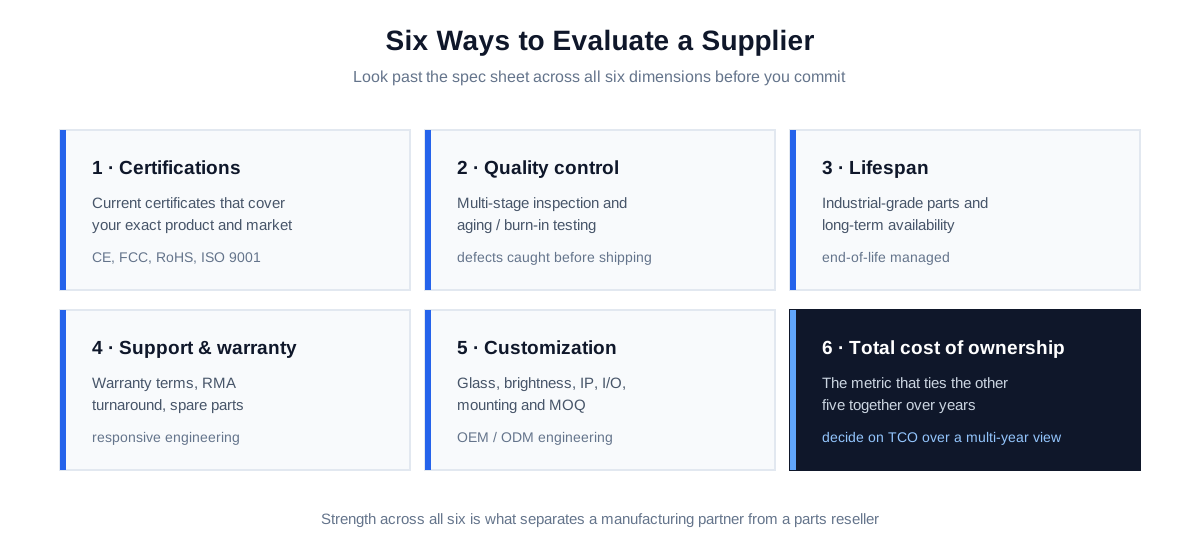
1. Certifications: require documented proof
Certifications are the baseline filter. They tell you a product has been tested against recognized safety, emissions, and environmental standards, and in regulated or public-facing settings they are often a legal requirement. The marks that matter most for industrial and commercial displays include:
- CE for the European market, covering the Low Voltage and EMC directives.
- FCC for electromagnetic compatibility in North America.
- RoHS for restriction of hazardous substances.
- CCC for the China market, where applicable.
- UL for electrical safety where your insurer or jurisdiction requires it.
- ISO 9001 at the company level, which certifies the quality management system behind the product.
The practical move is to ask for the actual certificates, check that their scope covers the exact product you are buying, and confirm they are current. A supplier that can produce documentation quickly is usually one that takes compliance seriously. For reference, KoreTouch is ISO 9001 registered and ISO 14001 certified, carries CE, FCC, and RoHS compliance, and is recognized as a National High-Tech Enterprise. Certificates covering your specific product and market are available on request.
2. Quality control: how defects are caught before they ship
Two suppliers can quote the same panel and ship very different reliability, because reliability is built step by step on the production line. A serious manufacturer runs quality control at several stages:
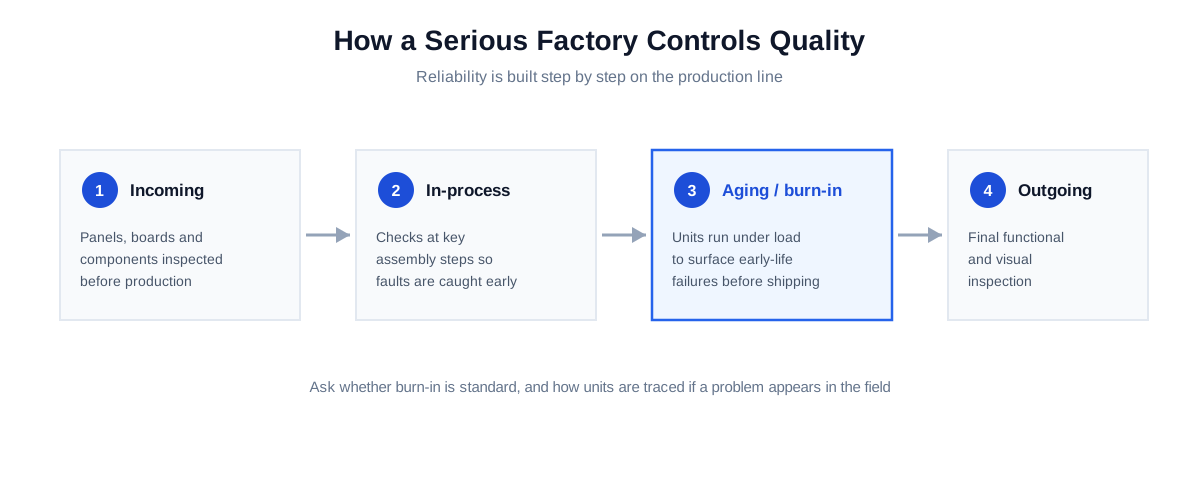
- Incoming inspection of panels, boards, and components before they enter production.
- In-process checks at key assembly steps so a fault is caught and contained early.
- Aging and burn-in testing, where finished units run under load for an extended period to surface early-life failures before they reach you.
- Outgoing inspection and functional testing on the finished product.
Ask what the process looks like, whether burn-in is standard, and how units are traced if a problem appears in the field. The answers show whether a factory truly manages its quality.
3. Product lifespan and component longevity
Industrial deployments are measured in years, and this is where consumer-grade hardware quietly fails you. Two questions matter:
- Are the components industrial-grade? Industrial panels, wide-temperature parts, and continuous-duty design last in conditions that retire commercial hardware early.
- Is the platform available for the long term? If a key component goes end-of-life a year after you deploy, you face a costly redesign or a fleet of mismatched units. A supplier with lifecycle and end-of-life management can keep a platform consistent across a multi-year rollout.
Reliability also comes from construction. Features such as optical bonding, which removes the air gap so moisture and dust cannot collect inside the display, and sealed, wide-temperature enclosures are what let a unit run untouched for years and keep field service to a minimum.
4. Technical support and warranty
The relationship does not end at delivery. Before you buy, get clear answers on the warranty period and what it covers, the repair and replacement (RMA) process and its turnaround, the availability of spare parts, and how quickly engineering responds when something is wrong. For a deployment that has to stay up, responsive support is worth more than a small saving on unit price. Confirm KoreTouch's current warranty terms and support process for your project as part of the quote.
5. Customization and OEM / ODM capability
Off-the-shelf rarely fits an industrial application exactly. The supplier's ability to adapt the product to your environment is often the deciding factor, and it is where a manufacturer with real engineering depth pulls ahead of a reseller. Useful questions include whether they can change the cover glass, brightness, IP rating, mounting, and I/O, whether they can run custom bonding and touch options, what the minimum order quantity is, and whether they can prototype before volume.
This is a particular strength of KoreTouch. The team develops integration concepts directly from your project requirements, without needing initial technical drawings, and applies in-house capabilities such as Class 1,000 cleanroom optical bonding to deliver a unit tuned precisely to the deployment.
6. Total cost of ownership
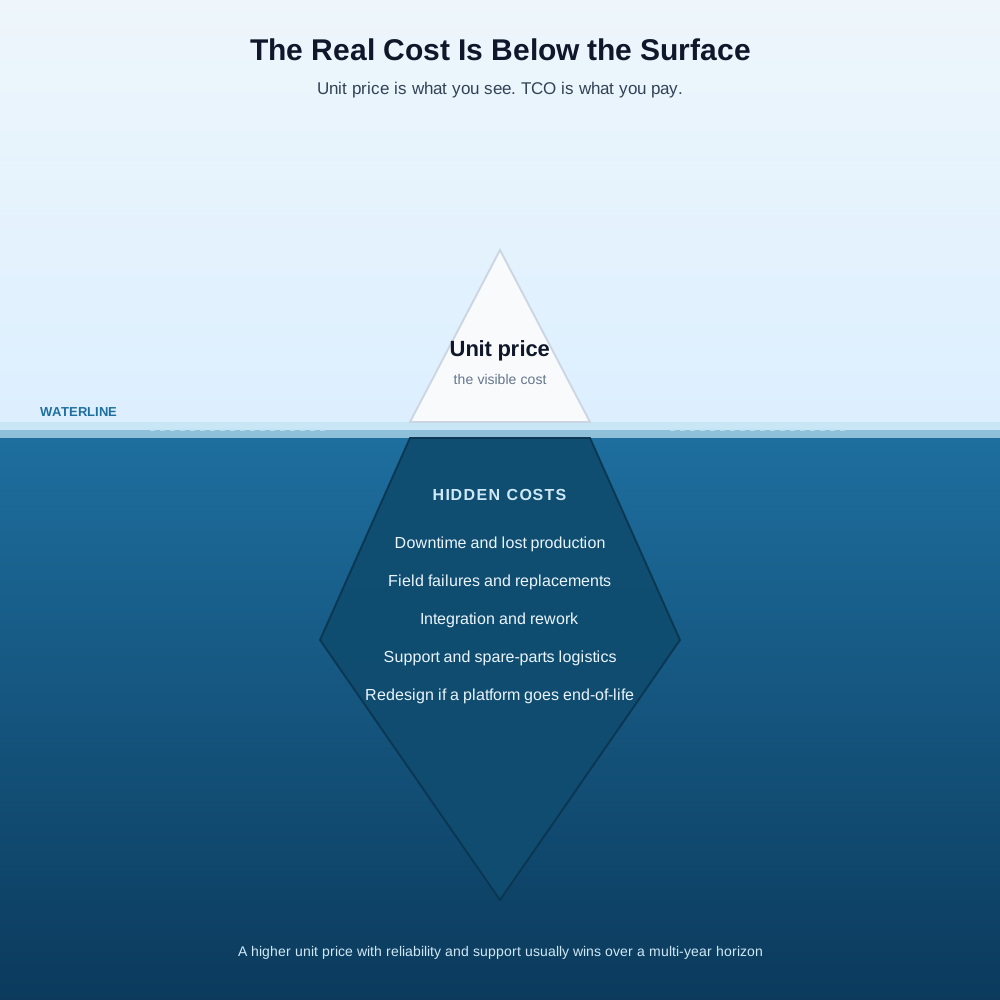
The cheapest quote is often the most expensive choice. Unit price is the visible cost; the costs that decide ROI sit below the surface:
- Downtime and lost production when a terminal fails.
- Field failure and replacement rates over the deployment's life.
- Integration and rework when a unit does not fit cleanly.
- Support burden and spare-parts logistics.
- Redesign cost if a platform goes end-of-life mid-rollout.
A slightly higher unit price that comes with industrial reliability, certification, and long-term support almost always wins over a multi-year horizon. Evaluate the total cost of ownership over the deployment's life.
The procurement checklist
Questions to put to any industrial display or panel PC supplier before you commit:
- Can you provide current certificates (CE, FCC, RoHS, and others for my market) covering this exact product?
- What does your quality control process look like, and is aging or burn-in testing standard?
- Are the components industrial-grade, and how do you manage end-of-life and long-term availability?
- What is the warranty period, what does it cover, and what is the RMA turnaround?
- Can you customize glass, brightness, IP rating, I/O, and mounting, and what is the minimum order quantity?
- Can you share reference deployments or field reliability data for similar applications?
- What is the typical lead time, from sample to volume?
Key takeaways
- The supplier and the total cost of ownership decide whether a rollout succeeds.
- Require current certificates that cover your exact product and market, and confirm the company-level quality system.
- Ask how quality is controlled on the line, including aging and burn-in, and how the platform is managed against end-of-life.
- Weigh warranty, support responsiveness, and customization capability alongside price.
- Choose on total cost of ownership over a multi-year horizon.
KoreTouch, an ISO 9001 and ISO 14001 certified National High-Tech Enterprise headquartered in Shenzhen, builds industrial displays and panel PCs from your requirements, with in-house optical bonding and OEM / ODM customization. Explore the product range, read about optical bonding, or contact the team to discuss certifications, customization, and a quote for your project.