Engineering Excellence
Optimizing Sunlight Readability and Mechanical Durability in Industrial Displays: A Technical Analysis of LOCA Optical Bonding
Industrial touch displays and All-in-One PCs frequently operate under challenging ambient light and high-vibration conditions. LOCA optical bonding eliminates the air gap between the LCM and touch panel to improve contrast, prevent internal fogging, and distribute mechanical shock.
1. Introduction
Industrial touch displays and All-in-One PCs frequently operate under challenging ambient light conditions and high-vibration environments. Traditional air bonding (frame bonding) creates a perimeter seal that leaves a physical air gap between the liquid crystal module (LCM) and the touch panel (TP). This structural air gap introduces two major operational liabilities: significant optical degradation due to internal light reflection, and the risk of internal moisture condensation (fogging) in humid environments. To eliminate these issues, liquid optical clear adhesive (LOCA) optical bonding has become the standard for high-reliability industrial applications.
2. The Optical Principle of Index Matching
The primary cause of poor screen readability under direct sunlight is the refractive index mismatch between materials. Glass has a refractive index (n) of approximately 1.5, while the air inside an air-gapped monitor has a refractive index of 1.0. When light passes through these mismatched boundaries, it reflects back toward the user.
According to Fresnel's equations, the reflection coefficient (R) at normal incidence is calculated as:
In a standard air-bonded display, light encounters two distinct glass-to-air interfaces, resulting in a total surface reflection of roughly 4.5% to 5%. Combined with high ambient glare, this reflection severely reduces the contrast ratio.
LOCA optical bonding resolves this by introducing a specialized liquid adhesive with a refractive index of approximately 1.49, matching the optical properties of the glass surfaces. By creating a continuous optical medium, the internal reflection is reduced to less than 1%, while the contrast ratio under direct sunlight increases by up to 20 times.
3. Critical Process Stages in Production Validation
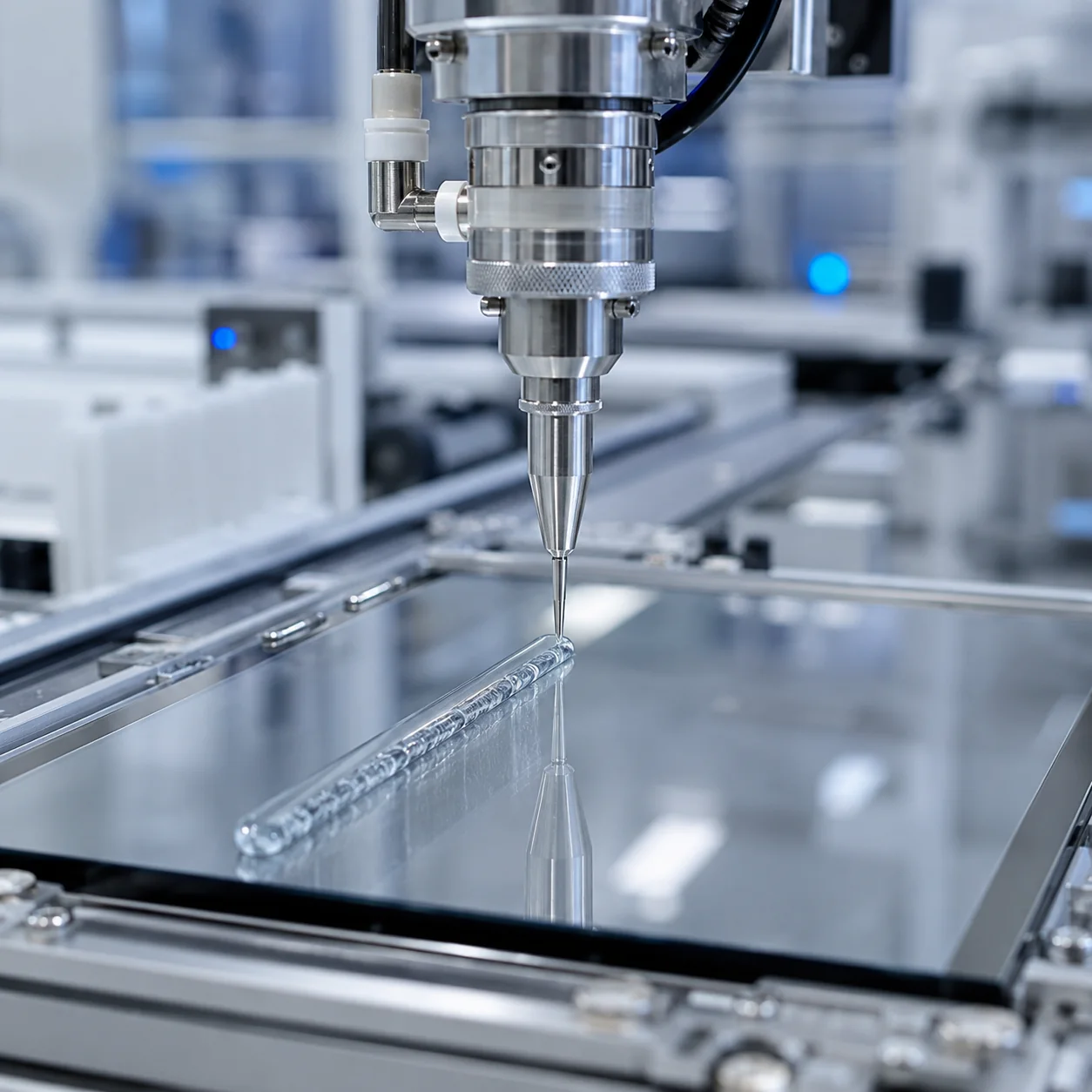
Achieving a zero-gap, bubble-free optical layer requires a highly controlled fabrication process. The reliability of the final display relies on critical technical phases within the overall manufacturing workflow:
3.1 Plasma Surface Treatment
Before adhesive application, the glass surfaces undergo automated atmospheric plasma treatment. This process alters the surface morphology at a microscopic level, increasing surface energy and hydrophilicity. This ensures optimal wetting of the liquid LOCA and maximizes long-term adhesion, preventing delamination.
3.2 Vacuum Lamination
The integration of the TP and LCM is executed inside a sealed vacuum chamber. Dispensing and initial pressing under vacuum conditions prevent atmospheric air from becoming trapped within the liquid adhesive layer, eliminating the primary source of macro-bubbles.
3.3 Autoclave Defoaming
Following a precise UV pre-curing stage that stabilizes component alignment, the display enters a pressurized autoclave. By applying uniform thermal and pneumatic pressure (typically several atmospheres), any remaining microscopic or nano-scale air bubbles are forced to dissolve into the adhesive matrix, ensuring 100% optical clarity.
4. Mechanical Protection and Environmental Isolation
Beyond optical optimization, the cured LOCA layer acts as a mechanical shock absorber. In a standard air-gap design, localized physical impacts on the touch glass compress the air layer and transfer concentrated stress directly onto the fragile LCM, often causing panel damage or color distortion.
A fully bonded display establishes a solid-state, zero-gap structural integration. The cured adhesive layer exhibits high viscoelasticity, allowing it to absorb and distribute mechanical shock uniformly across the entire framework. Furthermore, completely filling the internal cavity physically prevents the ingress of dust, moisture, and corrosive industrial gases, eliminating internal condensation and sensor degradation.
5. Conclusion
While LOCA optical bonding requires higher initial capital investment in automated dispensing, vacuum lamination, and curing infrastructure compared to traditional frame bonding, it provides essential technical certainty. For industrial system integrators and equipment manufacturers, the elimination of internal reflections, structural condensation, and localized impact vulnerabilities ensures a lower total cost of ownership and reliable performance throughout the equipment lifecycle.