Technical Deep Dive
How to Solve Industrial Display Brightness Issues
In factory workshops, outdoor kiosks, warehouses, and medical settings, industrial displays are often required to operate reliably under direct sunlight, strong backlighting, or high-intensity ambient lighting for ext...
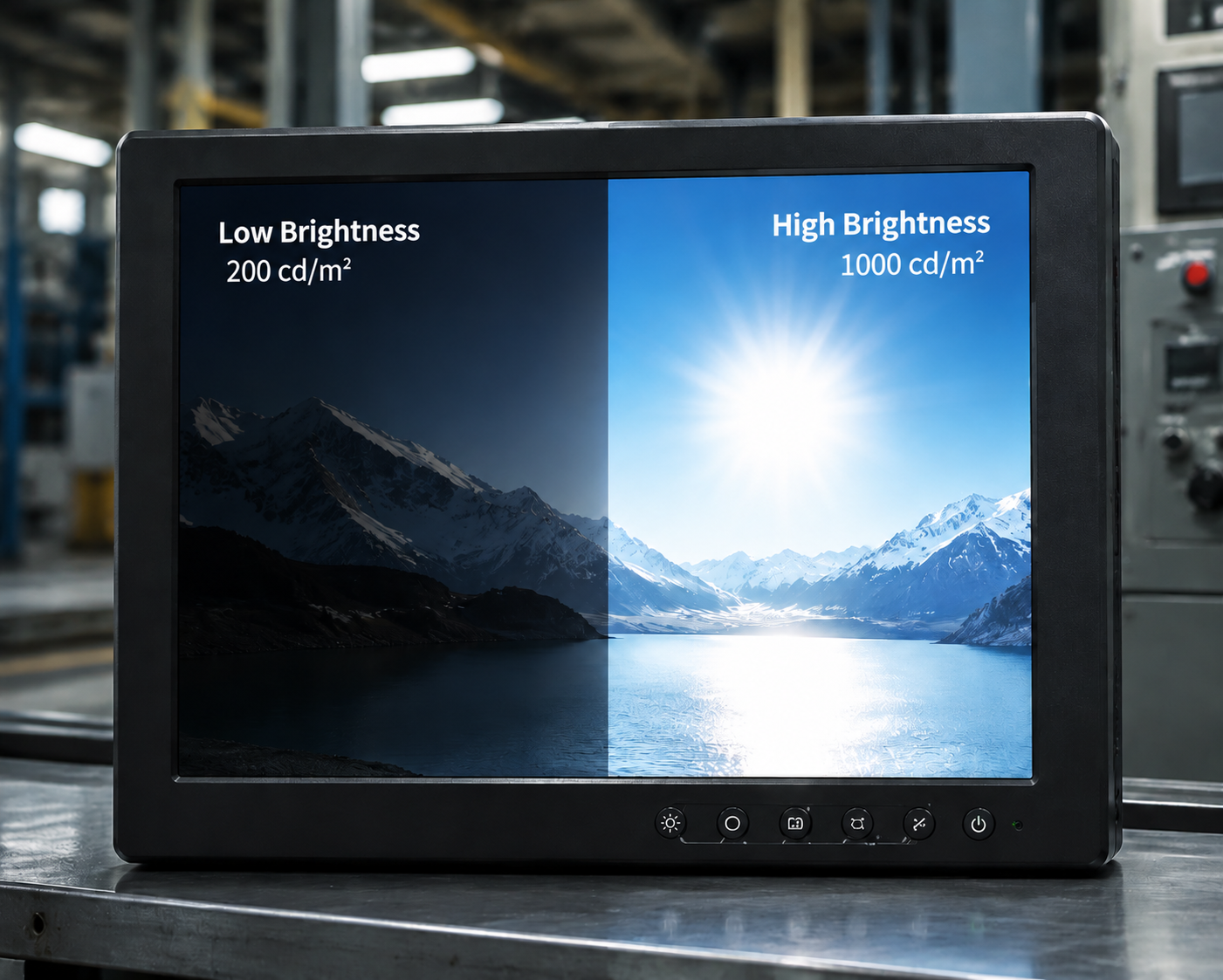
In factory workshops, outdoor kiosks, warehouses, and medical settings, industrial displays are often required to operate reliably under direct sunlight, strong backlighting, or high-intensity ambient lighting for extended periods. Unlike standard consumer-grade monitors used in office environments, an industrial display that becomes hard to read is more than a minor inconvenience — it can slow down operations, cause costly errors, or even create safety risks. Insufficient brightness, glare, and poor viewing angles remain among the most common concerns raised by engineers and procurement teams when selecting an industrial display.
As a manufacturer focused on industrial touch display solutions, Koretouch has extensive experience supplying customized monitors for industrial automation, smart manufacturing, medical devices, logistics, and outdoor self-service terminals. This article outlines the root causes of display brightness issues and offers a practical, engineering-based approach to solving them — along with selection guidance for anyone currently struggling with screen visibility problems.
Why Industrial Displays Become Difficult to Read
Ambient Light Overwhelms Standard Panels
Standard consumer monitors typically offer brightness levels of around 250–350 nits (cd/m²), which is more than sufficient for office or home use. However, once the same panel is installed outdoors, near a window on a production line, at an open-air charging station, or under intense factory lighting, the screen content is easily washed out by ambient light, leaving operators staring at little more than their own reflection.
Glare and Reflection Compound the Problem
Even when brightness is technically adequate, a display without anti-glare treatment or optical bonding will suffer from mirror-like reflections under strong light. This is especially problematic for touchscreen applications, where surface reflection issues are magnified by the additional touch layer.
Temperature and Environmental Factors Degrade LCD Performance
Industrial environments frequently involve extreme heat, cold, dust, or oil contamination. Standard LCD panels can experience brightness degradation — or even response lag — under extreme temperatures. This is the underlying cause behind many complaints about outdoor displays "getting dimmer" over time.
Limited Viewing Angles Reduce Visibility at Certain Positions
In embedded installations or applications requiring wide viewing angles (steep upward or downward viewing), standard TN panels often fall short. Even when brightness measured head-on meets specifications, off-axis viewing can result in significant color distortion and brightness loss.
A Systematic Approach to Solving Brightness Issues
Select a High-Brightness Panel Matched to the Actual Environment
This is the most direct and fundamental solution. Brightness requirements are typically categorized by environment:
- General indoor conditions: 350–500 nits is sufficient for most indoor production lines and control panel displays.
- Bright or semi-outdoor environments (e.g., workshops near windows, loading docks): 700–1000 nits high-brightness panels are recommended.
- Full outdoor or strong backlight environments (e.g., gas stations, EV charging stations, outdoor kiosks, transportation hubs): 1000–1500 nits or higher ultra-high-brightness panels are recommended to ensure clear visibility even under direct midday sun.
Koretouch offers industrial monitors across multiple brightness tiers, from standard to ultra-high brightness, allowing us to recommend the right configuration based on the customer's actual installation environment — avoiding both under-specified visibility and unnecessary cost from over-specifying brightness.
Optical Bonding + Anti-Glare Treatment
Increasing backlight brightness alone does not fully resolve reflection issues. Optical bonding — filling the air gap between the touch panel, cover glass, and LCD module with optical adhesive — significantly reduces internal reflection, improves contrast and light transmission, and strengthens resistance to shock and moisture ingress. Combined with an anti-glare (AG) matte surface treatment or anti-reflective (AR) coating, this effectively suppresses ambient light reflection, keeping on-screen content sharp and readable even in bright conditions.
Wide Temperature Design for Stable Brightness Output
For high- and low-temperature environments, industrial displays should use wide-temperature-range panels along with appropriate heating or thermal management design, typically supporting operating temperatures from -20°C to 60°C or beyond. This ensures consistent brightness output regardless of temperature fluctuations, rather than "flickering" performance in extreme heat or cold.
Integrated Ambient Light Sensing and Automatic Dimming
For applications where brightness requirements vary significantly with time of day or weather — such as round-the-clock outdoor self-service terminals — an ambient light sensor can be integrated to automatically adjust backlight brightness. This ensures readability under strong daylight while avoiding excessive glare or unnecessary power consumption at night, balancing visibility with energy efficiency.
Thoughtful Installation Angle and Structural Design
Beyond the panel itself, the mounting method significantly affects real-world visibility. VESA mounting, embedded installation, and open-frame designs each need to account for viewing angle, sun-shading structures, and enclosure color (dark enclosures absorb more heat, which can raise internal temperature and affect brightness performance). Only when these factors are considered together can a high-brightness panel deliver its full performance potential.
Selection Guidance: Choosing the Right Industrial Display for Your Project
When evaluating a display solution for your project, we recommend assessing the following factors together:
- Installation environment — Indoor, semi-outdoor, or fully outdoor? Is there direct sunlight or a strong reflective light source?
- Viewing distance and angle — From what distance and angle will operators typically view the screen?
- Ingress protection requirements — Is dust/water protection (IP65 or higher), explosion-proof, or corrosion-resistant construction required?
- Touch requirements — Will operators need to wear gloves? Is the environment subject to oil or dust that would favor resistive over capacitive touch (or vice versa)?
- Size and interface — What display size fits the available enclosure space, and what signal interfaces are required (HDMI, DisplayPort, VGA, etc.)?
Brightness is only one factor in overall display performance. A truly reliable industrial display solution requires brightness, ingress protection, touch technology, and structural design to be considered together — this is what ultimately solves the combined challenge of "hard to see, doesn't last, doesn't fit."
Conclusion: Making Every Industrial Display Truly Easy to See — and Built to Last
Brightness may appear to be a single specification, but solving screen visibility issues in industrial settings is a systems-engineering challenge that spans panel selection, optical structure, thermal management, and installation design. Chasing a high nit rating alone — without anti-glare treatment, wide-temperature design, or proper environmental adaptation — rarely solves the underlying visibility problem on the factory floor.
Koretouch has years of experience in industrial touch display technology, providing customized display solutions from 7" to 23.8" for industrial automation, smart warehousing, medical devices, and outdoor self-service terminals. Our product range covers high-brightness panels, optical bonding, wide-temperature design, multiple touch technologies, and flexible mounting options — and our engineers can provide tailored recommendations based on your specific application environment.
If you're facing challenges with display brightness, visibility, or reliability in your industrial application, get in touch with the Koretouch team today. Our engineers will work with you to identify the right display solution for your project — one that's truly easy to see and built to last.
Work with KoreTouch
See Industrial Monitors, Optical Bonding, High-Brightness Displays. Contact us at sales@koretouch.com.