Engineering Excellence
Enclosure Cutouts Aren't a Loophole: How Network Ports, Antennas, and Fan Openings Affect Outdoor Touchscreen IP Rating
Outdoor touchscreen IP rating is never an inherent property of the finished unit — it is the combined performance of the entire sealing system, including every cutout.
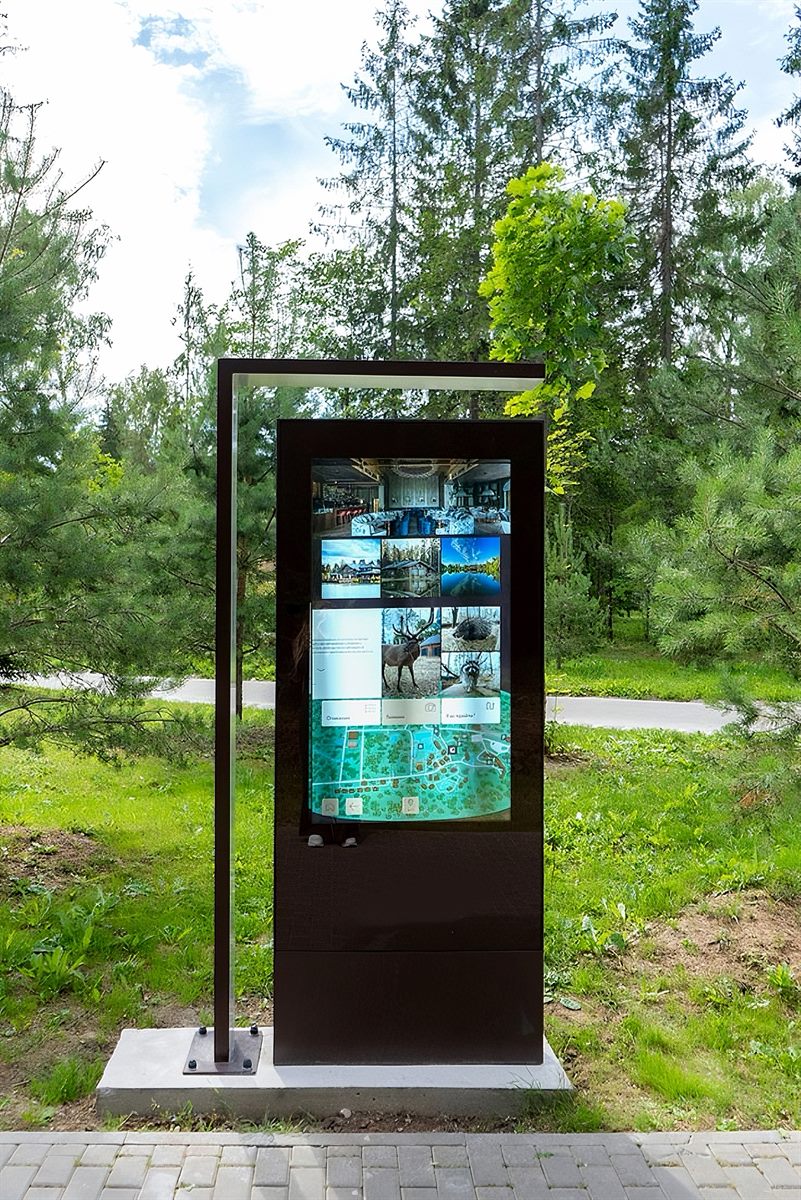
Every outdoor kiosk, digital signage unit, fuel-station terminal, or EV-charging interface project eventually comes down to the same line on the spec sheet: IP65? IP66? IP67? What many integrators overlook is that outdoor touchscreen IP rating is never an inherent property of the finished unit — it is the combined performance of the entire sealing system. Every cutout made in the enclosure to route a network cable, mount an antenna, or vent a cooling fan is a deliberate breach in that sealing system. Get the cutout wrong, and an enclosure rated IP65 on paper can fail to reach even IP54 in the field.
This article breaks down the three most common enclosure cutouts in outdoor equipment — network ports, antennas, and fans — explaining why each one threatens outdoor touchscreen IP rating, and what proven sealing methods the industry uses to keep that rating intact.
Why a Cutout Can Reduce IP Rating to Zero
IP ratings, as defined by IEC 60529, are measured on a fully sealed enclosure. The IP65 or IP66 figure a manufacturer publishes is generated with no cutouts and every seam fully compressed. The moment an enclosure includes cable routing holes, antenna mounting holes, fan openings or louvered vents, buttons, indicator lights, viewing windows, seams, hinges, and latches, each of these becomes a potential weak point in the protection rating.
It is a well-established principle in enclosure engineering that an unsealed cutout causes a waterproof enclosure to lose its rated NEMA or IP classification. Without the correct sealing accessory at each opening — a proper cable gland, a waterproof connector, a sealed fan module — even the highest published IP number is only a laboratory result, with no guaranteed relationship to real-world field performance. This is exactly why evaluating outdoor touchscreen IP rating cannot stop at the front-glass specification of the display. Every functional cutout in the enclosure has to be reviewed individually.
Network Port Cutouts: Routing RJ45 Without Compromising IP Rating
A network interface is a near-universal requirement for any connected outdoor terminal — and it is also one of the most commonly mishandled cutouts, often drilled and wired in the field with no thought given to sealing until water shows up inside the enclosure.
The common failure mode. Drilling a bare hole in the enclosure and routing an unprotected cable through it, or mounting a standard indoor RJ45 jack directly onto sheet metal, leaves a gap between the cable and the cutout wall. Rain, dust, and condensation travel along that gap directly into the enclosure. This kind of shortcut is close to a direct hit against outdoor touchscreen IP rating.
Engineering solutions.
- Waterproof cable glands. Sized to match the actual cable outer diameter (M20 / M25 / M32, etc.), a properly torqued cable gland compresses a sealing grommet to achieve IP66, IP67, or even IP68 protection at the cable entry, while also providing strain relief so repeated cable pull does not degrade the seal over time.
- Field-serviceable waterproof RJ45 connection systems. An outdoor-rated RJ45 receptacle with a UV-resistant, shielded housing, paired with a mating sealed cable gland that passes the RJ45 connector through, can reach IP67 at the connection point — allowing quick disconnect and reconnect for maintenance without ever sacrificing outdoor touchscreen IP rating.
- A sizing detail that matters more than it seems. The sealing rating of a gland is only valid for the cable diameter range it was designed for. A mismatch of even one millimeter can leave the grommet under-compressed, and the published IP number becomes meaningless in practice. Any credible sealing plan specifies gland size against the measured cable OD — not the number on a datasheet.
Treating the network port as an independent sealing node, engineered to the same standard as the rest of the enclosure, is what allows outdoor touchscreen IP rating to hold up at the system level rather than remaining a number on a spec sheet.
Antenna Cutouts: Keeping Wi-Fi, 4G, and GPS Feeds From Becoming Water Paths
As more outdoor all-in-one units integrate 4G/5G modems, Wi-Fi, and GPS, the antenna feed-through and bulkhead connector become a second high-risk point for outdoor touchscreen IP rating.
The common failure mode. Antenna cable is routed through a gap in the enclosure seam, or the antenna base is mounted directly against sheet metal with no gasket. After extended exposure to UV and temperature cycling, the sealant around the antenna base cracks, and water tracks in along the mounting stud.
- Bulkhead RF connectors. Standard bulkhead connectors — SMA, N-type, or RP-SMA — with an integrated O-ring allow the antenna feed cable to pass through the enclosure wall without breaking the sealing plane. This is the standard method for maintaining outdoor touchscreen IP rating at an antenna feed-through.
- Dual-layer sealing at the antenna base. A rubber gasket compressed between the antenna mount and the enclosure surface, combined with a secondary bead of neutral-cure silicone sealant, protects against both UV-driven sealant degradation and the thermal expansion/contraction cycles typical of day-night outdoor swings.
- Cable routing that avoids standing water. Internally, the feed cable path should avoid low points where water can pool, and the bulkhead penetration itself should be placed on a side wall or under a drip edge rather than on a top surface exposed to direct rainfall.
Antenna cutouts are small and easy to overlook during inspection, but small diameter and hidden placement are exactly why they rank among the most common field leak points once units are deployed.
Fan Cutouts: Balancing Thermal Management With Outdoor Touchscreen IP Rating
Fan cooling and enclosure sealing are, by nature, opposing requirements — cooling wants airflow, sealing wants to block it. This tension is where outdoor enclosure design is tested the most.
The common failure mode. Cutting a louvered opening and bolting in an off-the-shelf axial fan may solve the heat problem on paper, but it opens a direct channel for wind-driven dust, rain, and even insects. In an outdoor environment, this approach almost always drives the effective IP rating to zero.
Three proven engineering approaches:
- Sealed fan module + labyrinth-baffled louver. An outdoor-rated fan module (IP55/IP56) paired with a louver designed with a maze-like internal baffle forces incoming air to change direction multiple times, blocking direct water ingress while still allowing airflow. This is typically the most cost-effective solution.
- Heat exchanger / air-to-air heat exchanger. For applications that require IP65 or higher outdoor touchscreen IP rating, direct-vent cooling is usually abandoned in favor of a plate heat exchanger or a compact air-conditioning module. The enclosure stays fully sealed, transferring heat across a barrier without exchanging air — this is the mainstream cooling architecture for IP65/IP66-rated outdoor all-in-one units today.
- Positive-pressure filtered airflow. Maintaining a slight positive pressure inside the sealed enclosure, combined with a filtered intake, lets air escape outward through minor gaps while making it far harder for external dust to migrate in against the pressure gradient. This method balances cooling efficiency with sealing integrity and is common in high-heat-load deployments.
Choosing among these three is fundamentally a trade-off between cooling power draw, unit cost, and the target outdoor touchscreen IP rating. This is exactly why serious outdoor terminal manufacturers run thermal simulations based on actual board/PC heat output at the project design stage, rather than cutting a vent hole as an afterthought once the enclosure geometry is already locked.
Coordinating Enclosure Sealing With the Touchscreen Itself
Enclosure cutouts are only one link in the chain that determines outdoor touchscreen IP rating. The sealing design of the touch panel itself matters just as much, and the two have to be engineered together:
- Front bezel sealing. A continuous rubber gasket or foamed silicone strip is required between the touchscreen bezel and the enclosure cutout, with sealed counterbores at every mounting screw.
- Weatherability of the touch stack itself. KoreTouch's projected capacitive (PCAP) touch panels, for example, use Mohs-7 hardness tempered glass with AR/AF/AG surface treatment, fully optically bonded with Wacker silicone LOCA in a Class-1,000 cleanroom. This fills the air gap between the cover glass and the LCD, which does more than improve sunlight readability and impact resistance — it structurally closes off the internal path where moisture and dust would otherwise accumulate, complementing the enclosure's own IP sealing strategy.
- Touch controller tuning for wet and rain-exposed conditions. A frequent field failure mode is a touchscreen that stops registering — or triggers false touches — when rain pools on the glass. Solving this requires water-rejection algorithms at the controller level, using self- and mutual-capacitance data together to distinguish a real finger touch from a water film.
In short, assessing outdoor touchscreen IP rating on any all-in-one unit means evaluating both the enclosure's cutout sealing and the touch panel's own sealing structure and controller maturity — neither is sufficient on its own.
Don't Skip Verification: Retesting IP Rating After Cutouts Are Made
Many projects do the engineering work up front — correct glands, correct sealed fan module — and then skip the one step that actually confirms the result: a full-unit IP retest after final assembly. The IP rating of an individual component does not equal the IP rating of the finished assembly. Gasket compression, screw torque, and assembly tolerances can each independently cause a design that looks correct on paper to fail in testing.
Before scaling to production, we recommend completing at minimum:
- Full-unit spray testing (corresponding to IPX5/IPX6 water-jet intensity)
- Dust-chamber testing (corresponding to IP5X/IP6X exposure duration)
- A sealing re-check after high/low temperature cycling, to confirm gaskets have not taken a permanent set
- A post-UV-aging inspection of sealants and gaskets
Only after completing this verification loop can a unit's outdoor touchscreen IP rating be considered confirmed — rather than a theoretical value that only exists on the drawing.
Key Takeaways
- Published IP ratings are measured on a fully sealed enclosure; every cutout is a potential breach unless properly sealed.
- Network port cutouts require gland/connector sizing matched to actual cable OD, not catalog specs.
- Antenna feed-throughs need bulkhead connectors and dual-layer gasket/sealant protection against UV and thermal cycling.
- Fan cutouts require a deliberate trade-off between labyrinth-baffled vents, heat exchangers, or positive-pressure airflow to balance cooling with sealing.
- The touch panel's own optical bonding, surface treatment, and water-rejection algorithms are as important to outdoor touchscreen IP rating as the enclosure itself.
- Full-unit IP retesting after final assembly — not component-level ratings alone — is the only way to confirm real-world performance.
Conclusion: Design Cutouts In, Don't Patch Them In Afterward
Network ports, antennas, and cooling fans are functional requirements that virtually every outdoor touchscreen terminal has to accommodate. What actually determines whether outdoor touchscreen IP rating holds up in the field is not whether an enclosure has cutouts — it always will — but whether those cutouts were engineered as part of the design from the start.
KoreTouch has long focused on the structural engineering behind industrial touch and outdoor all-in-one systems — from optical bonding and surface treatment on the touch panel itself, to enclosure sealing, cutout engineering, and thermal design for your industrial panel PC or industrial display. If you want to confirm whether your design can actually meet the outdoor touchscreen IP rating your application requires, send our engineering team your cutout requirements and target IP rating.
Contact: sales@koretouch.com
The sealing methods and test procedures described here reflect common industry engineering practice. Actual project performance should be confirmed through on-site or lab testing under the specific application's conditions.