Product Engineering
All-in-One Industrial PC: Understanding the Differences Between Android, Windows, and Linux Systems
As smart manufacturing and industrial automation continue to accelerate, the industrial PC has become an indispensable core device across production lines, warehousing and logistics, power and energy, medical equipmen...
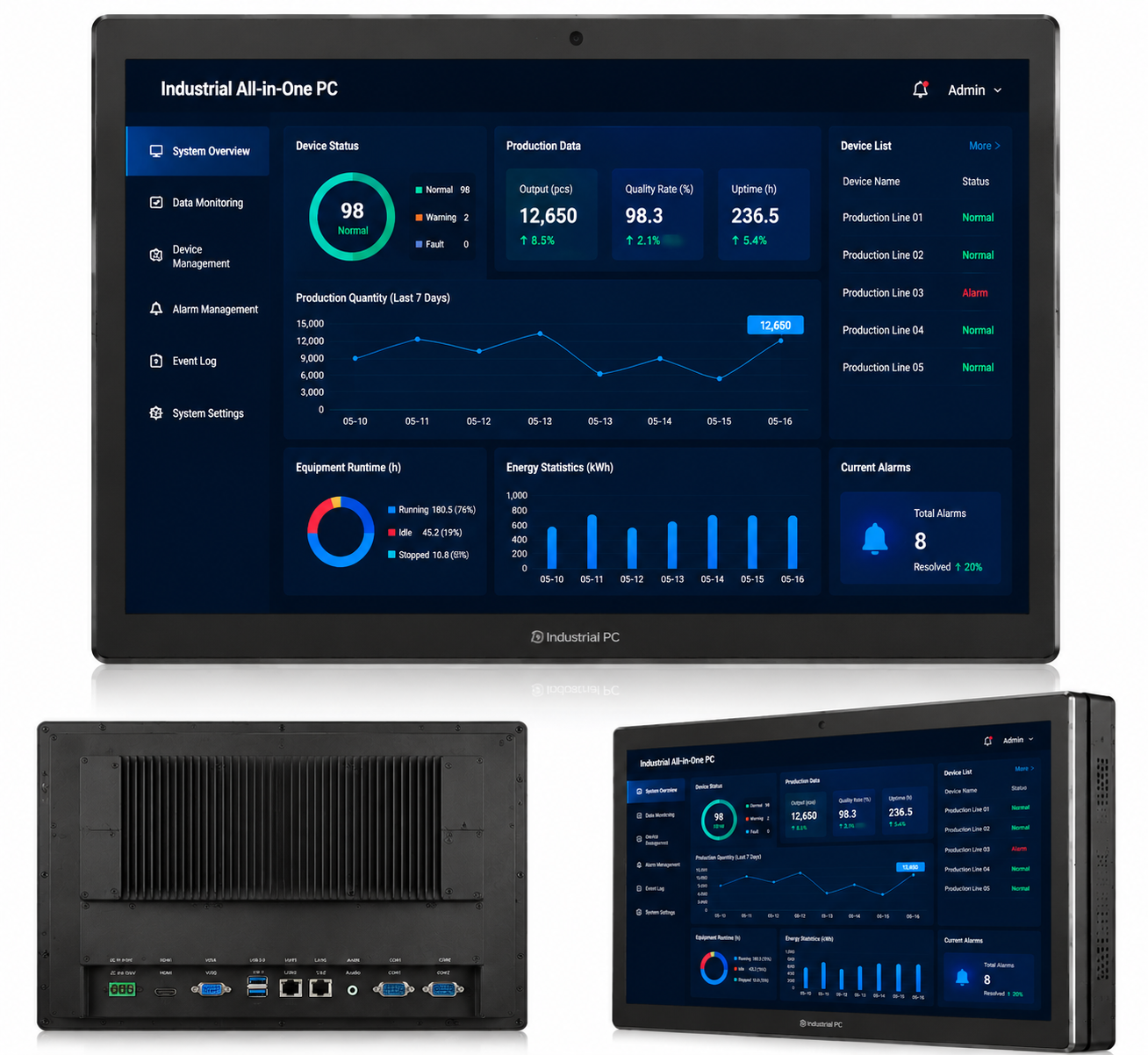
As smart manufacturing and industrial automation continue to accelerate, the industrial PC has become an indispensable core device across production lines, warehousing and logistics, power and energy, medical equipment, and smart transportation applications. As the carrier for human-machine interaction (HMI) and data acquisition and control, an all-in-one industrial PC must not only deliver industrial-grade reliability — dust-proof, waterproof, shock-resistant, and wide-temperature performance — but also make the right operating system choice at the software level in order to truly match the demands of real-world deployment.
Koretouch has long focused on the research, development, and customization of all-in-one industrial PCs and industrial touch panel products, providing customers worldwide with solutions built on three major operating system platforms: Android, Windows, and Linux. In this article, we break down the core differences between these three systems across technical characteristics, typical use cases, and selection guidance.
Android Industrial PC: Lightweight, User-Friendly, Built for HMI and IoT Terminals
Thanks to its intuitive graphical interface and rich application ecosystem, Android is increasingly adopted in industrial all-in-one PCs — particularly in ARM-based devices (such as those built on mainstream industrial-grade chips like the Rockchip RK3568/RK3588) that prioritize low power consumption.
Key advantages
- High development efficiency: Built on the mature Android SDK, interface development and secondary development cycles are short, making it ideal for HMI applications that require rapid iteration.
- Low power consumption and heat output: The ARM architecture is inherently low-power, making fanless, silent designs easier to achieve while maintaining long-term operational stability.
- Excellent touch experience: Full support for capacitive multi-touch enables smooth, responsive operation — well suited for terminals designed for frontline operators.
- Controlled cost: Overall hardware and licensing costs are relatively low, making it suitable for large-scale deployments.
Typical use cases
production line dashboards, barcode scanning terminals, self-service kiosks, and simple data acquisition and status monitoring interfaces — scenarios that demand strong visual interaction with relatively straightforward logic.
Windows Industrial PC: Broad Compatibility, the Backbone of the Industrial Software Ecosystem
Windows (including Windows 10/11 and Windows IoT) remains the most widely used operating system in industrial control, backed by decades of accumulated industrial software infrastructure.
Key advantages
- Unmatched software compatibility: The vast majority of industrial configuration software (such as SCADA systems, MES platforms, and PLC programming/debugging tools) is developed for Windows, minimizing migration costs for enterprises with existing systems.
- Strong hardware performance: Paired with x86 processors such as Intel Celeron/Core i3/i5/i7, Windows industrial PCs can handle complex data processing, multitasking, and demanding workloads like industrial machine vision analysis.
- Comprehensive peripheral and interface support: Mature, stable driver support for multiple COM ports, USB devices, and specialized industrial data acquisition cards.
- Well-established long-term supply and technical support: Ideal for industrial projects with strict lifecycle requirements.
Typical use cases
production line control systems, SCADA monitoring, networked equipment data acquisition, industrial machine vision inspection, and complex control systems that must interface with third-party professional software.
Linux Industrial PC: Stable, Secure, and Highly Customizable
For industrial applications that demand extreme stability, long-term maintenance-free operation, and heightened security requirements, Linux (including distributions such as Ubuntu, Debian, and embedded Yocto Linux) is often the more professional choice.
Key advantages
- Exceptional system stability: A streamlined kernel and controllable background services make it well-suited for critical devices that must run continuously, 24/7.
- Stronger security: Open-source and auditable, with strict permission management. Combined with custom trimming, this significantly reduces the attack surface — ideal for industries with high information security requirements, such as energy, rail transit, and government projects.
- Highly customizable: The kernel and file system can be tailored to project requirements, enabling a minimal, purpose-built embedded system with a smaller resource footprint.
- Long-term support at lower licensing cost: Most distributions are free of licensing fees, and community or vendor LTS (Long-Term Support) versions provide years of stable updates.
Typical use cases
industrial gateways, edge computing nodes, unattended field control units requiring long-term operation, and critical infrastructure projects with strict security and compliance requirements.
How to Choose the Right System
There is no universally "best" operating system — only the one best suited to your specific application. When advising customers on industrial PC selection, Koretouch typically evaluates the decision across the following dimensions:
| Consideration | Android | Windows | Linux |
|---|---|---|---|
| Android | Windows | Linux | Development difficulty & cycle |
| Low, quick to deploy | Medium, mature ecosystem | Medium-high, requires specialized expertise | Software ecosystem compatibility |
| Moderate | Strong | Moderate (customization required) | System stability |
| Good | Good | Excellent | Power consumption & heat |
| Low | Medium-high | Low to moderate | Security & customizability |
| Moderate | Moderate | Excellent | Hardware cost |
| Lower | Higher | Moderate | In short: if your core need is quickly building a human-machine interaction interface, an Android all-in-one industrial PC offers strong value for money. If you need compatibility with your existing industrial software ecosystem, a Windows industrial PC is almost always the necessary choice. And if you're pursuing maximum stability and information security, a Linux industrial PC is better equipped to meet the demands of long-term, unattended operation. |
Why Choose Koretouch?
As a professional all-in-one industrial PC manufacturer, Koretouch offers the following core capabilities:
- Coverage of both ARM and x86 technology paths, delivering flexible complete-system solutions across Android, Windows, and Linux platforms based on project requirements;
- Customization support ranging from 7-inch displays to large-format screens, accommodating wall-mount, embedded, and rack-mount installation formats;
- Industrial-grade reliability design — dust-proof, waterproof, wide-temperature, and shock-resistant — engineered to withstand demanding industrial environments;
- End-to-end service from hardware selection and system customization to driver development and volume delivery, helping customers shorten time-to-market.
Whether you're upgrading a production line with a stable, reliable HMI terminal or evaluating operating system platforms for a new project, choosing the right industrial PC operating system is a critical step in ensuring the long-term, stable operation of your entire automation solution.
If you have specific selection or customization needs for Android, Windows, or Linux industrial PC solutions, feel free to reach out to the Koretouch team at any time. Our engineers will provide professional selection guidance and tailored solutions based on your actual application scenario, helping bring your project to market efficiently.
Work with KoreTouch
See Android Panel PCs, Windows Panel PCs, Industrial All-in-One PCs. Contact us at sales@koretouch.com.